




Understanding the Necessity of FDA-Compliant Hoses
Q1: Why must FDA-compliant hoses be used in industrial production?
In food, beverage, or pharmaceutical production, a hose is the "surface in contact with the product." Ordinary industrial hoses may contain plasticizers or heavy metals that can migrate into the product due to temperature changes or friction. Using FDA-compliant hoses ensures that materials do not release harmful substances, maintains flavor purity, and meets the legal requirements for international health inspections.
1. What is the FDA 21 CFR Standard?
Within the regulatory framework of the U.S. Food and Drug Administration (FDA), Title 21 specifically regulates food and drugs. For industrial hose materials, we focus primarily on the chapters regarding "Indirect Food Additives." This means that while the material is not part of the food itself, it comes into contact with it; therefore, it must be proven not to release any hazardous substances.
2. In-Depth Analysis: Two Key Regulatory Standards
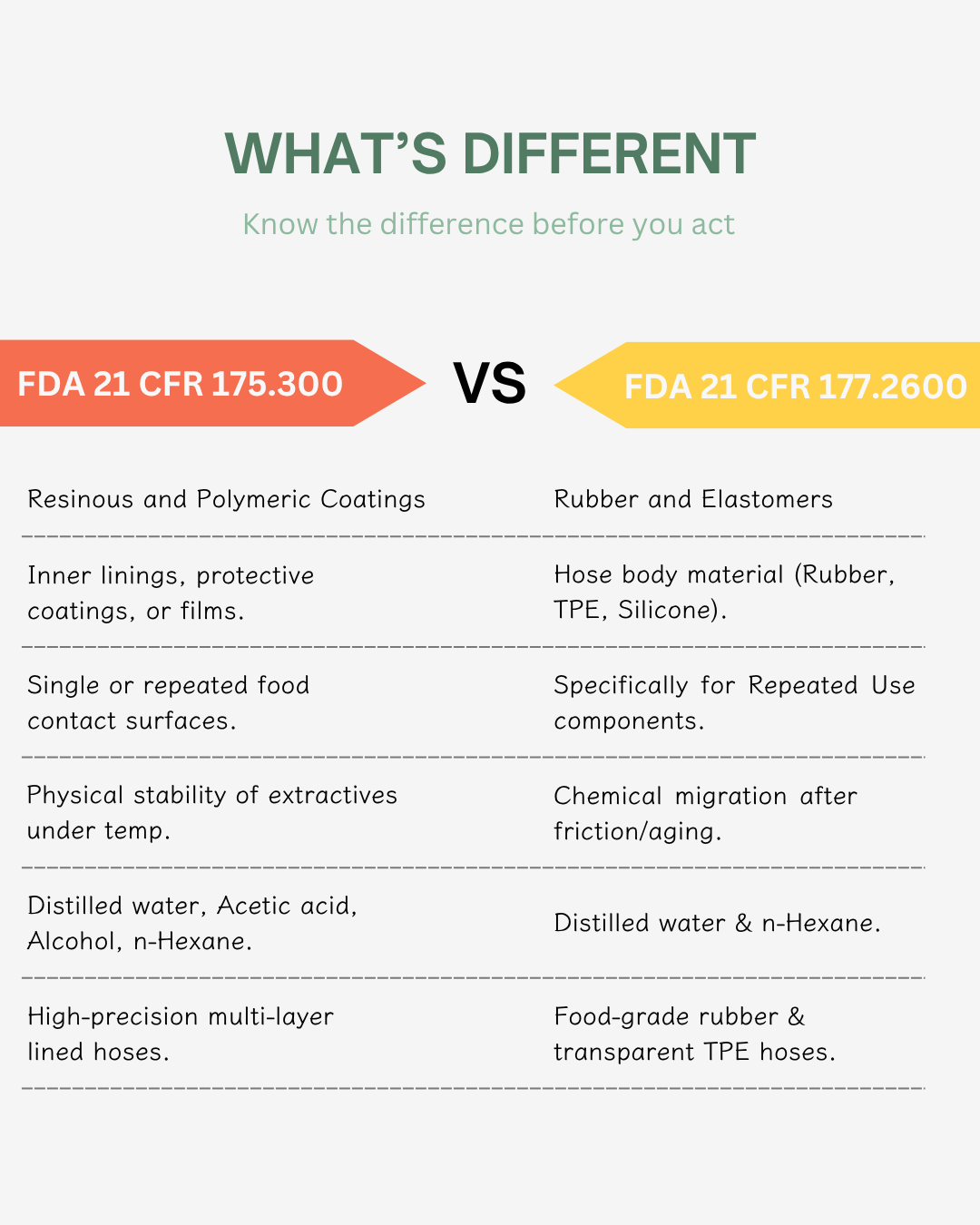
A. FDA 21 CFR 175.300 (Resinous and Polymeric Coatings)
This standard primarily targets surface coatings, resins, or composite materials that come into contact with food.
-
Core Value: Ensures the material remains chemically stable when in contact with food at various temperatures (from freezing to high-temperature sterilization) and different pH levels.
-
Testing Focus: Simulates various solvent environments to ensure that Extractives remain below safety limits.
This is the most critical regulation for elastomers such as Rubber, TPE, or Silicone.
-
Core Value: Regulates materials intended for repeated use to ensure that chemical components do not migrate into food due to aging or friction.
-
Testing Details:
-
Water Extraction Test: For the safety of aqueous (water-based) food transfer.
-
n-Hexane Extraction Test: Simulates the stability of dissolution in fatty food environments (e.g., edible oils, dairy products).
-
3. How to Read Test Reports?
A professional test report should include the following elements—details that procurement and quality control (QC) personnel should scrutinize:
-
Sample Description: Ensure the tested material is identical to the actual material used in your application.
-
Simulants: Does the report include tests for water, alcohol, or fatty simulants (n-Hexane)?
-
Conclusion: The report must clearly state "Pass" for all tested items.
The Jumboflex Advantage: Compliance Beyond Standards
-
Full Compliance Coverage: Whether you need basic material certification or strict compliance with FDA 21 CFR 175.300/177.2600, we provide the corresponding technical support.
-
Performance Upgrades: If standard specifications do not meet your needs, our team is ready to assist.
-
MIT Quality, Global Standards: We provide Made in Taiwan quality backed by 40 years of expertise, ensuring your production line remains both safe and durable.
Contact Us Now